
Intro
Based on the analysis of a typical process chain in metallurgical production, it can be stated that the potential for increasing efficiency has not been fully realized at several enterprises.
To achieve higher productivity is possible through implementation of a set of comprehensive measures connected with:
- raw material preparation;
- management of the blast furnace smelting process;
- specifics of charging and material distribution at the furnace top
as well as by means of integrated actions for improving the furnace reliability, extending the overhaul period and modernization of the cooling system, since increased blast furnace smelting intensity has a negative effect on lining wear and service life of structural components.
M HEAVY TECHNOLOGY experience makes it possible to raise hot metal production at blast furnaces, including those of large volumes, which seem to be operated at the limit of their capabilities.
These actions actions help:
✔️ increase the blast furnace production efficiency as the main process of steelmaking;
✔️ reduce production costs using existing capacities and lowering consumption of the fixed hot metal cost component, fuel, without involvement of additional funds.
1. Selection and optimization of burden conditions for sinter and blast furnace production to achieve the most efficient options with the lowest hot metal own cost.
Increasing blast furnace productivity starts with the study and analysis of burden conditions, which include:
- cost of iron ore materials;
- chemical composition and metallurgical value of the burden;
- system effect on the final fuel quality, depending on the material composition and ratio;
- consumption in blast furnace smelting;
- combined effect on the hot metal cost.
Based on the results obtained, M HEAVY TECHNOLOGY experts develop solutions for redistribution of raw material flows, which make it possible to optimize fuel consumption and improve the final product quality without additional investments.
For more details
Optimal distribution of raw material flows.
Optimization of the burden is the search for a balance between chemical composition of the components and the cost of a particular material.
The efficiency of sintering and blast furnace processes directly depends on distribution of raw material flows between key units. The final product cost is influenced not only by the price of raw materials but also by their availability and logistics.
Rational distribution of flows includes:
- optimization of logistics within the enterprise for reducing transportation losses and decreasing energy costs;
- stabilization of sinter quality by balancing raw material flows;
- flexible adjustment of ratios for compensation of fluctuations in raw materials or production load.
Introducing fine fractions into the blast furnace burden mix.
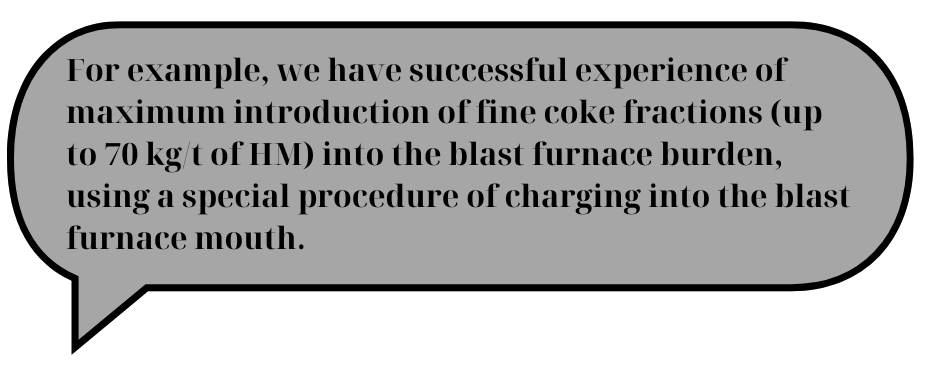
Adding fine coke fractions (coke nuts) and sinter screenings (fractions 3–5 mm) to the blast furnace burden with their subsequent charge into the furnace by means of a special algorithm not only reduces hot metal self cost but also leads to reduction of fuel consumption due to more favorable conditions for using reducibility of gases.
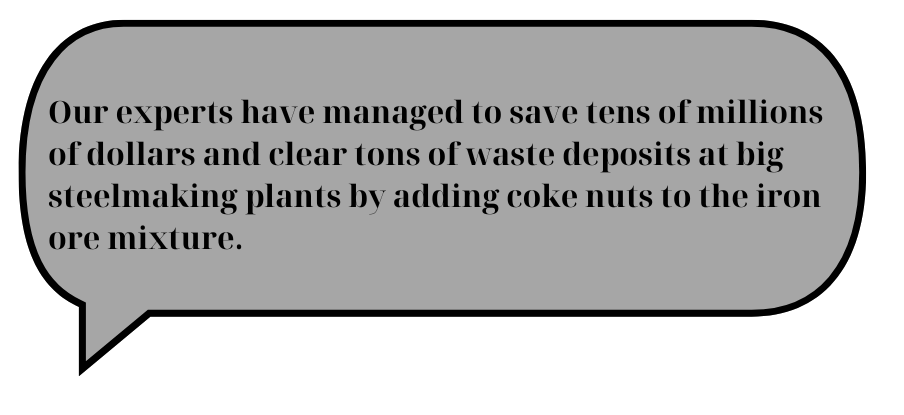
As of today, metallurgical enterprises on all continents are losing hundreds of millions of their gains, because they do not use the technology of introducing medium-sized coke fractions into the smelting process. Either they use it incompletely or incorrectly.
Due to understanding of process specifics, M HEAVY TECHNOLOGY experts know how to distribute and charge materials into the furnace for getting the best results.
For more details
2. Recommendations for most effective distribution of material flows of sinter and blast furnace production with the use of waste recycling.
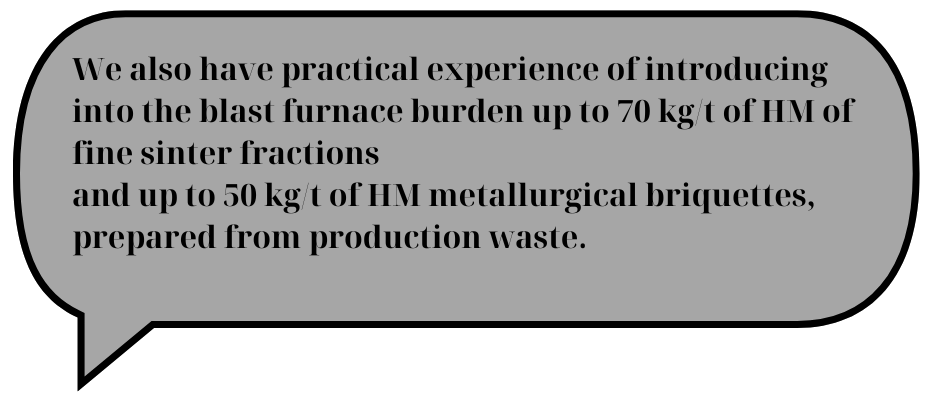
Recycling in the blast furnace production is a set of technological measures, aimed at returning metallurgical waste, such as dust, sludge, sinter screenings and scale into the sintering process or directly into the blast furnace smelting for reuse of valuable components.
Recycling allows for a closed-loop processing, reduces specific consumption of natural resources, decreases the volumes of waste disposal and increases environmental and economic efficiency of production.
Recycling through agglomeration.
Waste (dust, sludge, screenings, oversized materials, etc.) is returned into the sinter plant burden, where it undergoes thermal treatment and is transformed into a full-value sinter, suitable for blast furnace smelting. This is the most common and technologically stable method, which allows for recycling of up to 100% of fine-dispersed waste.
Direct return into the blast furnace.
Certain types of metallurgical waste are allowed to be returned directly into the blast furnace without agglomeration stage. This approach requires strict adherence to granulometric composition and chemical composition standards of secondary materials to prevent disruptions in thermal and gas-dynamic conditions of the blast furnace smelting. Direct return into the blast furnace is more limited in use, if compared with return into the sintering process. A deep understanding of blast furnace charging particularities enables MHT experts to form the burden, based on the process specifics, ensuring maximum economic effect for the enterprise.
Advantages of both recycling methods:
✅ Reduction of ore and coke consumption;
✅ Reduction of disposal costs;
✅ Increasing reductibility of gases and decrease of coke and fuel consumption on the whole.
For more details
4. Practical recommendations for blast furnace charging aimed at maximal use of gas reducing capacity and reduction of coke and fuel consumption on the whole.
Proper use and knowledge of correct algorithms of blast furnace charging are key factors for a successful blast furnace smelting and ensure minimal fuel consumption, reliability of the cooling system and stable operation of the blast furnace as a whole.
A successful solution of the task of efficient blast furnace top material distribution allows for decreasing hot metal self cost and, consequently, that of finished rolled products, enhances reliability of the blast furnace operation, extends the overhaul period and significantly reduces repair costs.
In modern practice various charging methods are used. Each of them has its own design and technological features.
1. Cone-type charging
Principle: The supply of charge materials into the furnace is carried out through a cone, which directs the flow into the mouth along a specific trajectory.
Advantages:
Simplicity of design and operation;
Reliability when operating on furnaces with low and medium capacity;
Minimal capital expenditures.
Disadvantages:
Limited capabilities for precise material distribution across the radius;
Increased heterogeneity of the burden across the furnace shaft section;
Less efficient control of gas dynamics and combustion zone formation.
2. Chute-type coneless charging
Principle: a system of intermediate bunkers and a distribution chute that allows for precise dosing and distribution of materials across the radius of the top.
Advantages:
High accuracy of charge placement;
Ability to form various charging schemes (ring-type, central, peripheral etc.);
Improved gas distribution across the height of the shaft.
Reduction in coke consumption due to optimization of the burden permeability.
Disadvantages:
Higher equipment and maintenance costs;
Complexity of control and the need for process automation;
Requires qualified personnel for proper adjustment of charging modes.
3. Hybrid and specialized charging schemes.
Modern blast furnaces can be equipped with combined systems that incorporate elements of traditional and coneless charging, as well as automated systems for real-time monitoring of material distribution (for example, 3D laser scanning).
Advantages:
Maximal flexibility and adaptability to changing smelting conditions;
Increased furnace lifespan due to uniform charging;
Reduced emissions and energy costs.
Disadvantages:
High implementation costs;
The need for constant technical support and modernization.
The choice of a specific scheme and charging algorithm depends on the blast furnace dimensions, available infrastructure, product quality requirements and enterprise strategy and is individually selected after analysis and diagnostics for every particular case.
5. Practical recommendations and selection of blast furnace operating modes with an increase of productivity by 10–20% above the design capacity.
An increase in hot metal consumption is a fairly common occurrence at metallurgical enterprises, where steelmaking and blast furnace capacities have been developed unevenly. M HEAVY experts have experience in operating the largest blast furnaces and can provide practical recommendations for increasing blast furnace productivity.
Extending the blast furnace overhaul period is a universal method of reducing costs.
An intermediate blast furnace repair can cost, for example, 15–20 million dollars, and that’s every 5–7 years.
But what if the overhaul period increases to 10 or even 12 years?
M HEAVY TECHNOLOGY’s work includes development of practical recommendations and selection of charging modes for blast furnaces with chute-type and cone-type charging devices. In combination with adaptive blast furnace cooling they ensure reliable operation and extend the overhaul period.
How does it work?
What does M HEAVY TECHNOLOGY suggest?
- Preliminary assessment of the current situation, identification of potential and key areas for improvement;
- Collection and analysis of necessary data;
- Development of measures for implementation in production process;
- Regular monitoring of implementation stages, realization and technical assessment of effectiveness;
- Regular consultations with the customer to coordinate actions;
- Providing the customer with reports on the project progress on a quarterly basis;
- Consultations and direct participation in development of changes and additions to technological regulations and instructions;
- Issuing recommendations for modernization of equipment, units and mechanisms, taking into account the level of technical and technological development in the relevant area.
Why M HEAVY TECHNOLOGY?
M HEAVY TECHNOLOGY is a community of specialists with many years of practical experience in construction, reconstruction and modernization of blast furnaces, who have participated in more than a hundred of projects on furnaces of various productivity and volume.
Cutting-edge tools.
To achieve the best results, M HEAVY TECHNOLOGY experts use state-of-the-art design methods:
✔️ CFD modeling:
Allows you to determine the best technological solution, predict results and find the weak link in the process chain.
✔️ BIM modeling:
Provides for a possibility to analyze the project and make changes long before the construction site work starts.
The use of BIM increases accuracy and consistency of data at all stages of the project. It minimizes errors and reduces the time for eliminating collisions between departments.
Ultimately, application of BIM significantly shortens project execution time, reduces the risk of inconsistencies both in design documentation and on the construction site and lowers capital construction costs.
✔️ 4D Construction Process Scheduling:
Modern BIM tools allow for coordination of a 3D model with the project timeline, taking into account the use of machinery, equipment, human resources and other aspects of the construction process. As a result, we obtain a 4D model of the Construction Process Scheduling (4D CPS).
What possibilities does 4D CPS provide?
– Visualization of the Construction Process: 4D CPS enables visualization of how the construction process evolves over time. This helps stakeholders better understand project progress, the sequencing of tasks, and potential conflicts.
– Improved Coordination: With the ability to track the real-time interaction between different construction activities, 4D CPS improves coordination between teams, machinery, and resources. This reduces miscommunication and improves efficiency.
– Enhanced Decision-Making: By providing a dynamic, time-based representation of the project, 4D CPS allows project managers and stakeholders to identify potential risks, delays, and bottlenecks before they occur, making it easier to make informed decisions.
– Resource Management: The integration of resources such as equipment, labor, and materials into the 4D model helps optimize resource allocation, ensuring that the right resources are available when needed, reducing idle time and cost overruns.
– Conflict Detection: The 4D model allows for early detection of potential clashes between different elements of the project, such as construction tasks, equipment, and structural elements. This proactive approach helps avoid costly delays caused by unforeseen issues.
– Enhanced Communication: Stakeholders, including clients, contractors, and suppliers, can more easily understand the project’s timeline and progress through the visual and time-based representation. This improves transparency and communication throughout the project lifecycle.
– Progress Monitoring and Reporting: The 4D CPS allows for the continuous monitoring of project progress, helping to ensure that the project stays on track and within schedule. Progress can be updated in real time, providing accurate and timely reports.
– Scenario Planning and Simulation: Project managers can use the 4D CPS to simulate different construction scenarios, allowing them to test various strategies, optimize workflows, and evaluate the impact of potential changes to the schedule or resources.
For our clients 4D CPS is the simplest way to understand how the construction or reconstruction of a facility takes place. It allows for tracking the adherence to construction timelines, quick identifying and eliminating the cause of schedule delays.
With 4D CPS we model not only appearance of the facility and structure of workshops but also time intervals for each stage. This includes such activities as equipment delivery and installation, material storage and distribution, as well as adjustment of technological systems and processes.
Each stage, starting from design documentation development up to equipment installation will be accurately reflected on the timeline. Moreover, any changes to the project can be promptly accounted for with adjustments made to the schedule and resources. Additionally, visual clarity of 4D CPS makes it easier to find an optimal solution for executing each stage of construction.
Thus, 4D CPS helps ensure a high level of accuracy, control, and transparency at all stages of design and construction, significantly increasing process efficiency and minimizing risks.
Justification of technological decisions and investments.
While cooperating with M HEAVY, the client receives a comprehensive technical and economic feasibility study (TEFS), which serves as a foundation for making investment decisions.
In this document we systematically review several options for implementation of a reconstruction or modernization project for sintering and blast furnace production. For each option we provide a detailed assessment of capital expenditures (CAPEX) and operational expenditures (OPEX), allowing the client to understand in advance, what resources will be required for implementation and future operation.
This approach ensures transparency at all stages and helps select the most effective strategy, taking into account technical, economic, and environmental requirements.
Result of cooperation with M HEAVY TECHNOLOGY
✔️ Increasing blast furnace productivity;
✔️ Reducing hot metal self cost;
✔️ Improving environmental safety;
✔️ Increasing blast furnace operation reliability with extension of the overhaul period.