
You Need High-Quality Piping Design Services
The role of pipeline systems in the life of an enterprise is often underestimated, but without process utilities no production process is possible.
Operability of a system and of an enterprise as a whole depends on the accuracy of hydraulic and aerodynamic calculations, correctly selected diameters and carrying capability of pipelines. Correct operation of the enterprise’s process pipelines has an influence on:
- Equipment service life;
- Production cost;
- High efficiency of the enterprise.
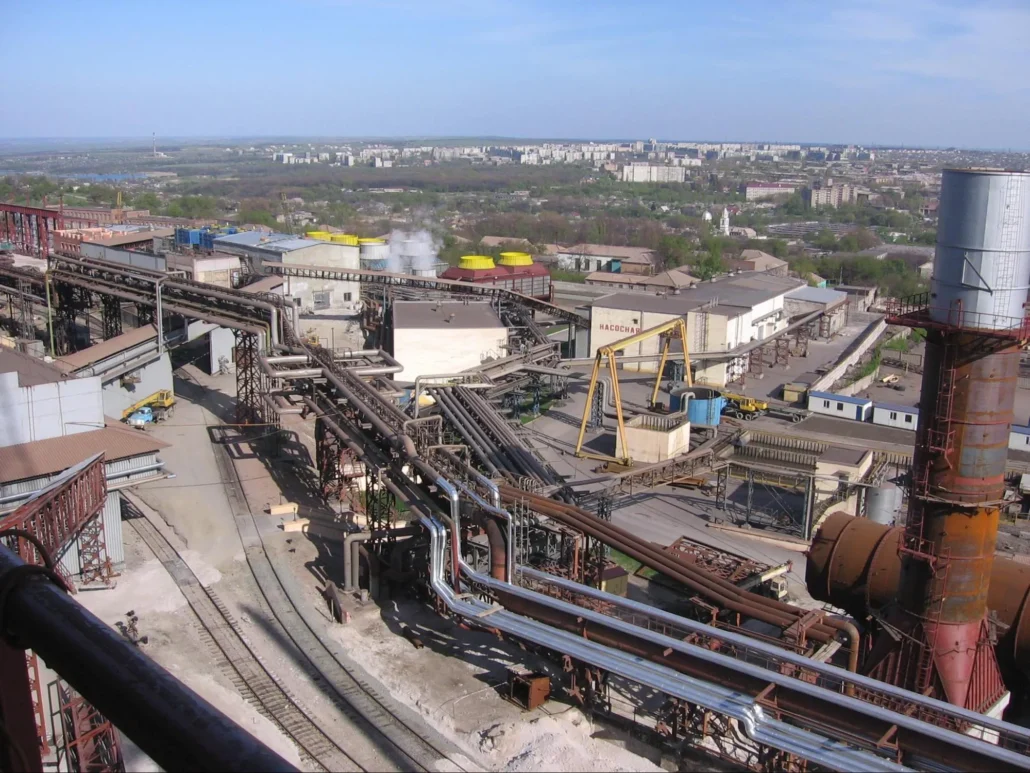
Process of Piping Engineering of M HEAVY TECHNOLOGY
M HEAVY TECHNOLOGY experts know how to create a high-quality system for any production process and can develop pipeline systems at all stages from engineering to author’s supervision.
✔️ Water supply and disposal of wastewater with different composition and quality;
No building, whether industrial or civil, can function without a water supply and sewerage system.
Depending on water quality and purpose of the water supply system pipelines can be made of:
☑️ steel;
☑️ cast iron;
☑️plastics;
☑️ copper.
All pipelines are designed and then installed according to strict rules and standards.
To ensure an uninterrupted water supply to consumers, as well as for effluent disposal, the designer often needs to take a non-standard approach to find individual solutions.
✔️ Water cooling of industrial units;
This is perhaps the most technologically complex pipeline system at the enterprise, on which the facility integrity and even the lives of the operating personnel depend.
The M HEAVY TECHNOLOGY team has wide experience in developing cooling systems, including blast furnace cooling, which is the highest level of skill for a design engineer.
The blast furnace cooling system includes a complex set of pipelines that provide circulation of cooling water to maintain temperature control and prevent overheating of the furnace structural elements.
The blast furnace cooling system can have thousands of pipelines, each of them has its own purpose, parameters and routing.
Before water reaches the cooled element it has to travel a long way which begins at the pump station. Then water passes through headers, heat exchangers, distribution networks and finally enters individual pipelines. To make all this possible each pipeline in the system must be coordinated with surrounding structures: process units, metalwork, pipelines of other systems and etc. Thus, high qualification and experience of all participants involved in the design process are required in order to correctly design a blast furnace cooling system.

✔️ Industrial pipelines of air separation products;
Another complex set of pipelines, without which no technological process can take place are utility lines to consumers.
Each production process requires a process utility, and often even several ones:
- oxygen;
- compressed air;
- nitrogen;
- argon;
- carbon dioxide.
Most of the media are produced at air separation plants and then distributed by means of pipelines throughout the enterprise.
Designing utility pipeline systems is a labor-intensive process that affects the service life, equipment performance and safety of technological processes.
The difficulty of supplying air separation products to the consumer is that sometimes several mediums should be supplied to the same equipment. Moreover, some energy carriers may be categorically incompatible with each other, such as natural gas and oxygen. It is what makes designing of such pipelines so complicated and labor-intensive.
Inert mediums such as argon or nitrogen are also necessary for technological processes. They are not explosive, and design norms for argon pipelines are not as strict as those for designing oxygen lines, but even in this case, strict control and compliance with safety measures are required to prevent negative consequences for human health and environment. Therefore, such systems are equipped with means of argon, nitrogen and oxygen level monitoring and signaling.
✔️ Combustible gas piping;
The combustible gas supply system is one of the largest at the plant, and therefore its designing requires strict adherence to relevant standards and regulations, as well as complex aerodynamic and hydraulic calculations.
Our company has extensive experience in designing pipelines and entire networks for:
- natural gas;
- blast-furnace gas;
- coke gas;
- converted waste gas;
- ferroaloy gases;
- pulverized coal fuel.
Designing combustible and explosive medium lines is only possible after training and getting permission for work with combustible gases.
Proper design, installation and operation of combustible gas piping systems are key factors for ensuring safe and reliable operation of the equipment.
Installation works are carried out by highly qualified personnel having appropriate specialization.
✔️ Pneumatic conveying of products and production waste.
Pneumatic conveying of products and production waste is a technology for transportation dry, bulk and granulated materials through pipelines by means of compressed air, nitrogen or other gas. This method is widely used in various industries due to its efficiency and versatility.
Proper design and operation of a pneumatic conveying system can significantly increase the efficiency of the production process, reduce costs and improve working conditions at the enterprise.
✔️ Lube/hydraulic piping.
Designing hydraulics and lubrication systems has its own features and requires special knowledge.
For drafting working documentation for hydraulics and lubrication systems it is also necessary to develop non-standard parts and units of mechanical components.
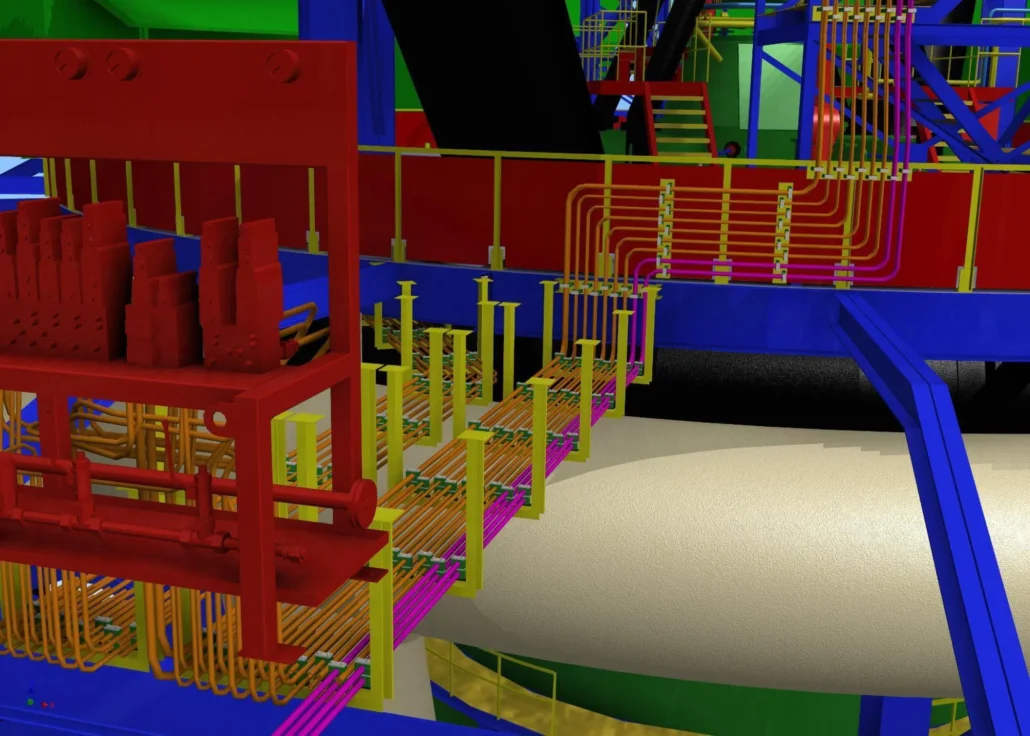
✔️ Dedusting system pipelines.
Dedusting piping design is carried out with consideration of the following parameters:
- transported gas-dust stream velocity (18 – 23 m/s), (such velocities prevent settling of suspended particles inside the pipelines);
- minimal aerodynamic resistance of the pipeline (sudden and sharp changes of the flow direction can result in its swirling and settling of suspended particles).
Another important factor in designing dedusting system pipelines is their abrasive wear. For its prevention M HEAVY TECHNOLOGY experts simulate the process of gas-dust mixture movement inside the pipelines in order to identify the most wearable areas. Subsequently, these sections are made either of thicker pipes, or abrasion-resistant steel grades or special weld overlays are used – all this increases the service life of the system as a whole.
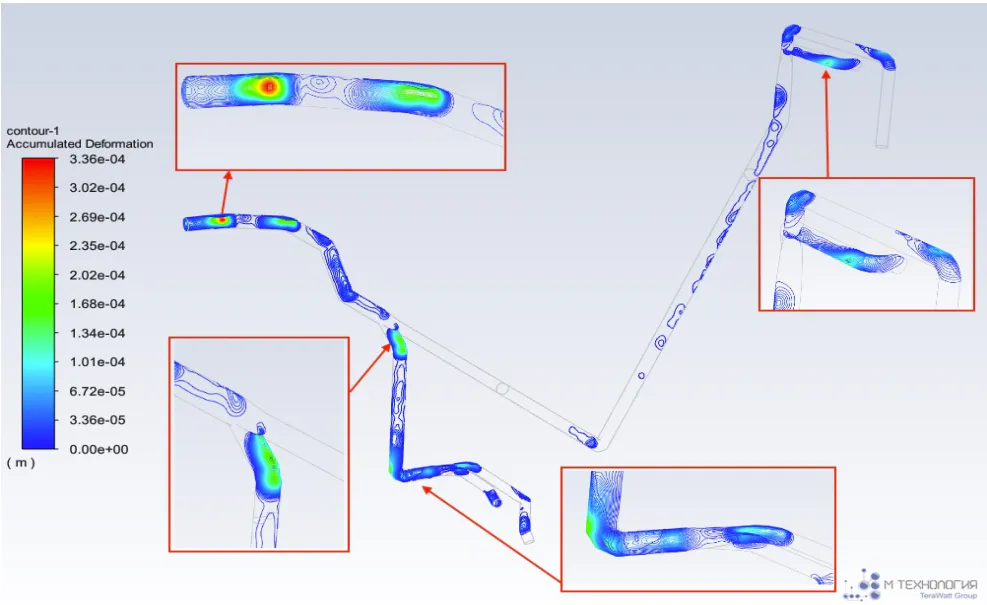
Fig. Most wearable piping sections
Piping Design Engineering Services
M HEAVY TECHNOLOGY carries out a full range of design works for process pipelines, starting from conceptual solutions to designer supervision and commissioning.
When designing pipelines for various industry branches the company’s experts perform engineering analysis by means of modern software, taking into account the Calculation code of the customer’s country.
Engineering analysis:
hydraulic calculations for determination of pipe diameters, flow rates and pressure drops;
thermal calculations for systems with heat transfer mediums;
calculations of pipeline strength and stability.
For pipeline hydraulic and aerodynamic calculations M HEAVY TECHNOLOGY uses modern software packages, which are especially suitable when design circuits are quite large.
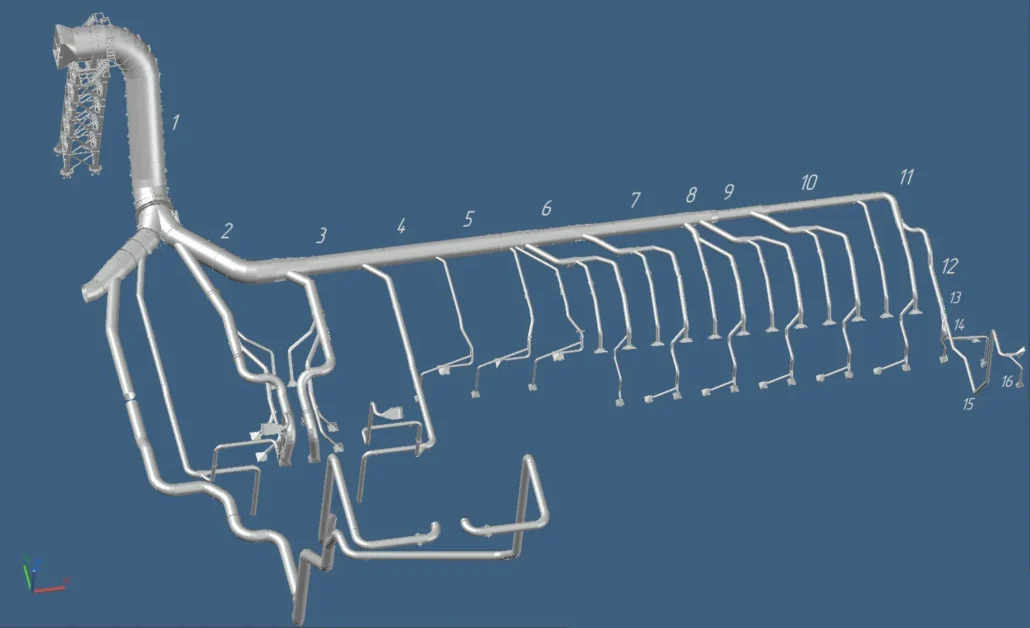
Fig. The right side of the bin trestle. Three-dimensional model, prepared for determining pressure losses and opening angles of control valves. PJSC “Ilyich Iron and Steel Works” in Mariupol.
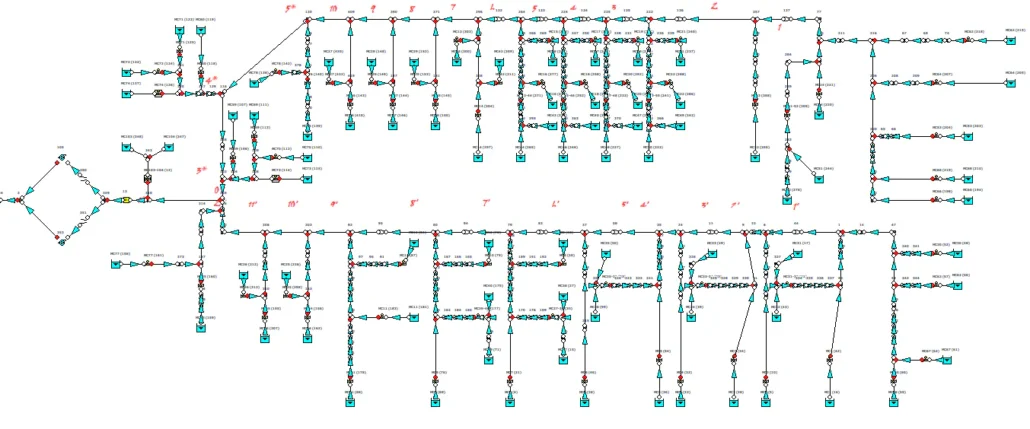
Fig. – Example of a design circuit. Aerodynamic calculation of the dedusting system of a bin trestle: determination of pressure losses, selection of an exhauster and determination of the opening angles of control valves.
At the customer’s request M HEAVY TECHNOLOGY experts can perform manual calculations and determine pressure losses for all sections, taking into account all local resistances. Pipeline diameters will also be selected with consideration of the optimal flow rate of the medium.
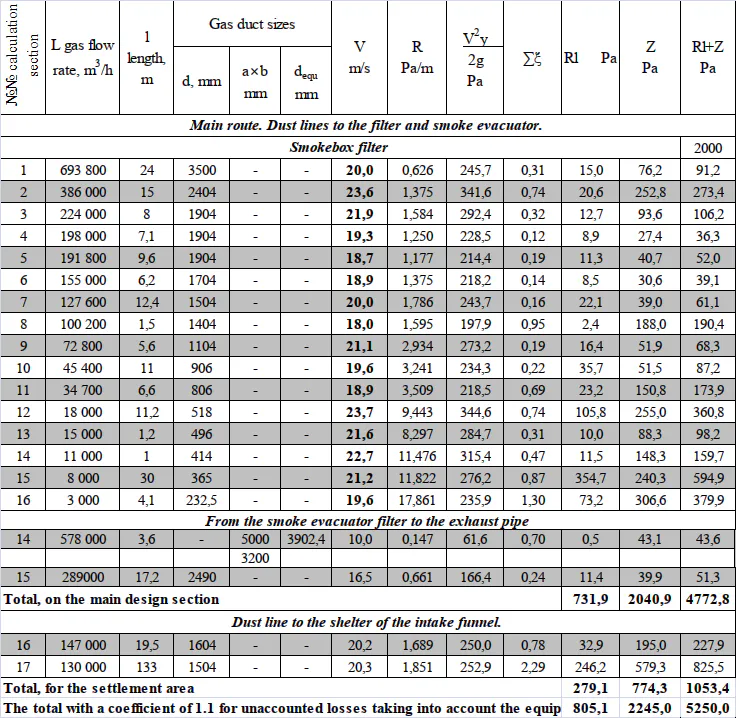
Fig. – An example of a part of a summary table, indicating all necessary parameters for different areas and determination of total losses.
M HEAVY TECHNOLOGY performs thermotechnical calculations for pipelines of any complexity, for example, piping of blast furnace cooling staves. We select equipment based on our calculations, check previously planned solutions – pumps, heat exchangers, etc.
M HEAVY TECHNOLOGY carries out strength calculations of pipelines for various industries, for example for power industry, metallurgy, petrochemical industry.
We perform strength calculations for thermal power plants, from cold pipelines to high-temperature steam piping with supercritical parameters (25 MPa, 540℃), and if necessary, consider seismic loads for earthquake zones.
Any process pipelines, with laying on a pipe rack or in the ground. Pipelines – steam, water and aggressive mediums of the chemical industry.
We select an optimal support and suspension system and provide loads with a calculation scheme for installation companies.
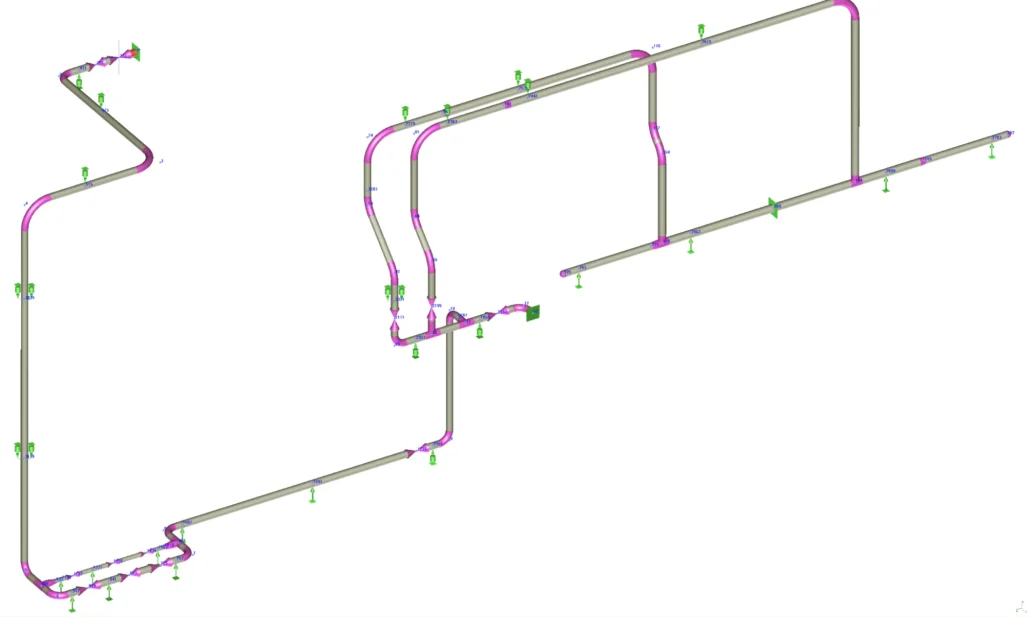
Fig. – A calculation model of a feedwater pipeline from feedwater headers to boilers. Construction of new compressed air station.
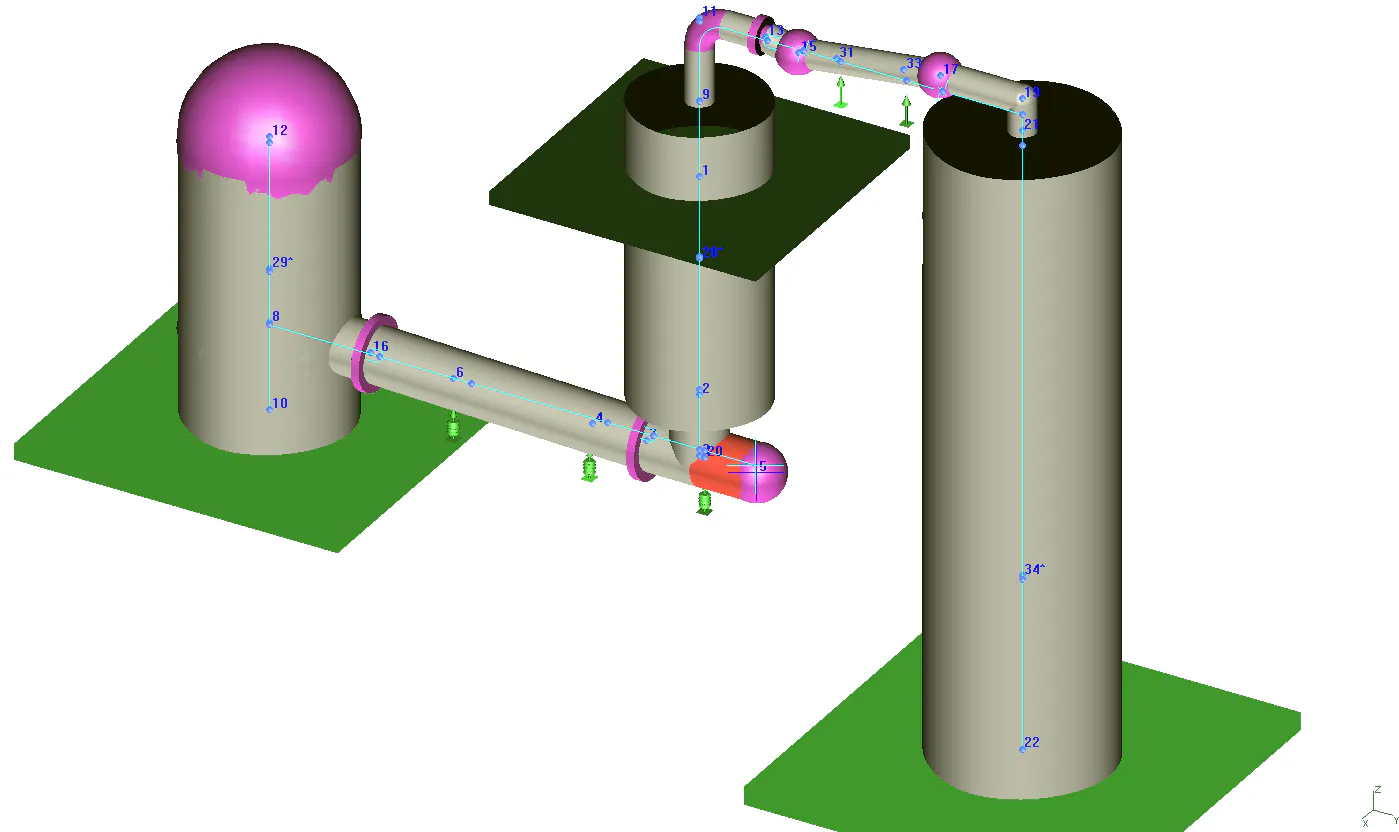
Fig. – Deformed condition during transformation from cold to operating state. A petrochemical industry facility – a scrubber, a collecting main (with installed expansion bellows) and a separator.
Development of project documentation:
- Development of P&ID diagrams;
- Creating 3D drawings;
- Issuing equipment and material specifications;
- Development of construction and installation plans.
Development of non-standard parts and units:
For choosing optimal solutions and correct operation of a pipeline system M HEAVY TECHNOLOGY team has qualified mechanical engineers who develop drawings for individual pipeline components, their connections, support systems and associated equipment.
Advantages of Piping Design by M Heavy Technology.
The advantage of working with M HEAVY TECHNOLOGY is unique design experience, designer’s supervision of installation of complex process piping systems and over seventy highly qualified specialists, which make it possible to quickly respond and make decisions on site. The use of modern software packages allows us to perform the work efficiently and in the shortest time possible.

Get a Free Consultation with Our Experts on the Most Efficient Methods and Technologies
M Heavy Experience in Piping Design and Drafting
M HEAVY TECHNOLOGY experts developed a project of reconstruction of gas booster stations and mixed gas pipeline systems at Iron and Steel Works “ArselorMittal Kryvyi Rih” to improve gas supply efficiency for technological processes.
The project included design of a new system for using blast furnace and coke gases, generated during blast furnace and coke production.
The project envisaged preparation of three gas mixtures:
– blast furnace and coke gas mixture (the main mixture);
– blast furnace-natural gas mixture (in the absence of coke gas, during a shutdown of coke production);
– blast furnace-coke-natural gas mixture (mixing of three gases is performed in the event of deviation in the calorific value of blast furnace and coke gases).
Mixing of gases is carried out at a gas mixing station, which consists of:
– feed control units for blast furnace, coke and natural gas;
– a blast furnace and coke gas mixing unit;
– a blast furnace and natural gas mixing unit;
– calorimeters;
– blast furnace, coke and natural gas flowmeters;
– on-off and control valves;
– blast furnace, coke oven, natural gas pipelines.
To control the amount of mixed gases it was planned to install control valves on the blast furnace, coke and natural gas pipelines.
The valves are controlled automatically by a signal from a calorimeter, installed after the gas booster station on the mixed gas pipeline.
Mixed gas is supplied to the plant’s main consumers by means of gas blowers, installed at the gas booster station.
Four gas blowers of Piller Blowers & Compressors GmbH with a capacity of 6000÷65000 m3/hour, P=30 kPa with a motor speed frequency control system were accepted for installation. This system made it possible to regulate capacity of the gas blowers by maintaining the required operating head pressure. The pressure in the pressure gas pipeline of the gas blower is determined based on the pressure drop in the gas pipelines and the pressure, required by the consumers.
In order to bypass existing utility piperacks and other structures M HEAVY TECHNOLOGY experts layed mixed gas pipelines on top of construction columns.