What Is Blast Furnace Lining?
Blast furnace lining is used for maintaining a designed profile of the furnace and protecting cooling staves and shell from destruction. It is exposed to high, changing and unevenly distributed temperatures, as well as to pressure of liquid iron, slag, gases, burden material, abrasion and chemical aggression of smelting products. Its resistance depends on basic properties of the refractories used.
The main task for ensuring long-term operation of a blast furnace is to keep the hearth and hearth bottom lining at a level, needed forsafe operation. Hearth and hearth bottom lining cannot be changed during intermediate repairs. Therefore, it must be designed for a full furnace campaign.
Development of a Blast Furnace Relining Project
The modern trend in designing blast-furnace crucibles is generally based on the following:
- Increasing the sump depth;
- Decreasing the hearth and hearth bottom thickness;
- Using new state-of-the-art refractory materials.
Therefore, the main criteria for development of a lining design are the resistance of the hearth and hearth bottom lining against the impact of liquid smelting products, alkalis, zinc (when using pulverized coal fuel) and economic feasibility.
Increasing the sump depth makes it possible to reduce the influence of negative hydrodynamics factors of the molten hot metal on the resistance of the junction zone between the hearth and the bottom and is one of the most important issues when designing blast-furnace crucibles.
Hearth and hearth bottom lining
The lining of the hearth and hearth bottom is combined and consists of a carbon lining and a “ceramic cup”.
Carbon lining is made of graphitized, conventional carbon and microporous carbon blocks. The materials have a high thermal conductivity, good resistance to corrosion, caused by hot metal, alkali resistance, and low gas permeability.

Fig. Fit-up assembly of carbon blocks.
For lining the top part of the hearth bottom mullite refractories are used. To protect carbon lining of the hearth walls against possible water penetration due to tuyere stock burnouts and against alkali and zinc impact a “ceramic cup”, made of aluminum carborundum refractories is used. Aluminum carborundum refractories have high thermal conductivity that contributes to skull formation. They also have a high mechanical strength and resistance to smelting products. The lining of the taphole openings is also made of aluminum carborundum.
Tuyere zone lining
Silicon carbide refractories are used for tuyere zone lining. These refractories are the most inert to alkalis. They have high thermal conductivity, high heat and wear and oxidation resistance.

Fig. Fit-up assembly of the tuyer zone lining
Bosh, belly and furnace stack lining
For lining the bosh, belly and furnace stack bottom in the zone of copper cooling staves silicon carbide refractories staves with inserts into the cooling staves are used. It ensures skull-melting process.
The belly and stack are additionally lined with gunning mix or alumina-carbon bricks. The thickness of the lining is determined by the design.
For stack lining in the area of cast-iron cooling staves microporous alumina-carbon bricks and dense fire-clay bricks are used. Their features are: good heat resistance, thermal conductivity, high wear resistance.
In its projects our company generally uses pre-lined cooling staves in these areas for blast furnace cooling systems.
The main advantages of cooling staves with a ceramic (silicon carbide, alumina-carbon) insert:
✔️ No joints between the bricks and the cooling stave body (the gap between the brick and the slot is 1-2mm. The gap between the bricks is 1-3mm);
✔️ Reduction in consumption of refractories and total cost of the lining;
✔️ The most solid monolithic lining construction and the joint between the bricks and cooling stave body;
✔️ Maximal heat transfer from the brick body to the cooling stave;
✔️ Rapid formation of the skull and, accordingly, protection of the lining and cooling staves;
✔️ Reduction of repair time.

Fig. Pre-lined stack cooling stave.
Quality Control of Blast Furnace Relining
Hearth-erosion measurement
One of the main issues for safety and long-term furnace campaign is automated real-time monitoring the thermal state of the peripheral and subhearth cooling as well as monitoring the temperature of the the blast-furnace crucible lining.
The thermal load in the furnace dynamically changes depending on the furnace run.
At the same time, the hardened layer of the skull in the hearth also changes significantly, so it is necessary to continuously determine operating parameters of this layer.
Determining and regulating the thermal state of the hearth can be considered an effective means of protecting refractory materials and increasing duration of the furnace campaign, including the effectiveness of technological measures for skull formation.
The software carries out automatic control of the following parameters:
- Thermal state of the the peripheral and subhearth cooling of the blast-furnace crucible;
- Erosion depth of the central part of the blast-furnace bottom;
- Residual thickness of the lining and skull for cooling staves rows and levels of thermocouple installation, vertical sections;
It also makes possible archiving measured and calculated data throughout the BF campaign, visualization of measured and calculated data in the form of graphs, drawings and cartograms, providing personnel with measured and calculated data on the thermal state of the blast-furnace crucible in the form of reports for any monitoring period and with information about the efficiency of sensors, indicating sensors that have failed or require checking. It gives warning information about measured and calculated parameters exceeding maximum permissible values.
The accuracy of all system functions is determined by the accuracy of initial information that comes from low-level systems.
Functioning of the system thermal state and residual thickness of the blast-furnace crucible lining monitoring is based on automatic control of thermal loads on the cooling staves of the peripheral cooling of the hearth and blast-furnace bottom, the subhearth cooling system and control of the lining temperature in places where thermocouples are installed.
For this control it is planned to install temperature gauges and flowmeters at the exit of the cooling staves in the peripheral cooling system and in the subhearth cooling sections of the blast furnace bottom.
For multi-circuit hot metal taphole coolers it is necessary to install similar sensors on each of the circuits.
To control residual thickness of the hearth and the blast-furnace bottom lining thermocouples are installed at 4-5 levels.
To control the depth of the hearth-bottom erosion thermocouples are provided at 2 levels. These are also installed between the tubes of the subhearth cooling system.
Actually, the software is a separate module:
- Input information for the subsystem:
1.1 temperature measurements of the hearth periphery and blast-furnace bottom lining at the levels where thermocouple are installed;
1.2 temperature measurements of the furnace bottom in the subhearth cooling system;
1.3 measurements of the temperature drop and water flow in the hearth and blast-furnace bottom cooling system (in the cooling staves of the hearth and tapholes and in the upper part of the blast-furnace bottom;
1.4 measurements of temperature drop and coolant flow rate in the subhearth cooling system.
2. Output informayion of the subsystem:
2.1 integral thermal load on controlled cooling staves;
2.2 thermal load on the center of the lower part of the blast-furnace bottom and sub-hearth cooling;
2.3 hearth-bottom erosion depth;
2.4 residual thickness of the hearth periphery and blast-furnace bottom lining;
2.5 skull thickness;
2.6 horizontal profiles of the blast-furnace crucible lining erosion along the furnace perimeter (along the rows of cooling staves and along the levels, where thermocouples are installed);
2.7 vertical profiles of lining erosion along the height of the blast-furnace crucible with scanning of periphery cooling staves;
2.8 fields of thermal loads in the periphery and central part of the blast-furnace bottom;
2.9 3D image of the erosion surface of the blast-furnace crucible;
2.10 lining temperature trends;
2.11 trends of heat load changes on controlled peripheral cooling staves;
2.12 trends of heat flow changes for the furnace bottom and subhearth cooling system.
Diagnostics of the stack lining condition.
One of the main tasks to ensure the blast furnace campaign duration is maintaining the save stack lining condition that is safe for cooling staves operation.
Maintaining the stack working profile, due notice in the event of skull slipping, incrustation processes, increase/decrease of total heat losses makes it possible to ensure smooth operation, reliability and duration of the furnace campaign and to save coke up to 10 kg/t of hot metal and more.
One of the ways to ensure efficiency, safety and duration of a blast furnace campaign is automated real-time monitoring of the thermal state and operating profile of the stack and controlling heat losses.
Software implementation of mathematical models automatically controls:
• trends in lining temperature changes by the levels of thermocouple installation;
• local specific thermal loads on the stack lining in places where thermocouples are installed;
• condition of the stack working profile;
• residual lining thickness in places where thermocouples are installed;
• skull thickness;
• horizontal profiles of lining erosion along the furnace stack perimeter at the levels of thermocouple installation;
• vertical profiles of lining erosion (scanning of the erosion surface along the sections of the thermocouple installation);
• stack wear surface development in a color scale.
It calculats and desplays trends of total heat losses in the blast furnace cooling system, provids the personnel with measured and calculated data about the stack lining condition in the form of reports for any period of monitoring, and with information about the sensors operability with indication of those which are faulty or require verification, gives warning information about measured and calculated parameters exceeding maximum permissible values.
The accuracy of all functions implemented in the system is determined by the accuracy of the input information coming from low-level systems.
Blast Furnace Reline Services of M HEAVY TECHNOLOGY
The company provides a full range of services in designing of blast furnace production complexes, in particular reconstruction and modernization of blast furnaces, including relining.
M HEAVY TECHNOLOGY experts perform engineering and supply of the lining for the whole blast furnace, starting from the blast-furnace crucible to the top, using microporous carbon blocks and a ceramic “cup” in the hearth and blast-furnace bottom and silicon carbide bricks in the bosh area and furnace stack. They make calculations for different furnace zones, depending on the processes taking place in them.
M HEAVY TECHNOLOGY is the author of a patent for implementation of “adaptive” cooling systems with pre-lined copper cooling plates for solving lining wear problems and extending the cooling staves service life.
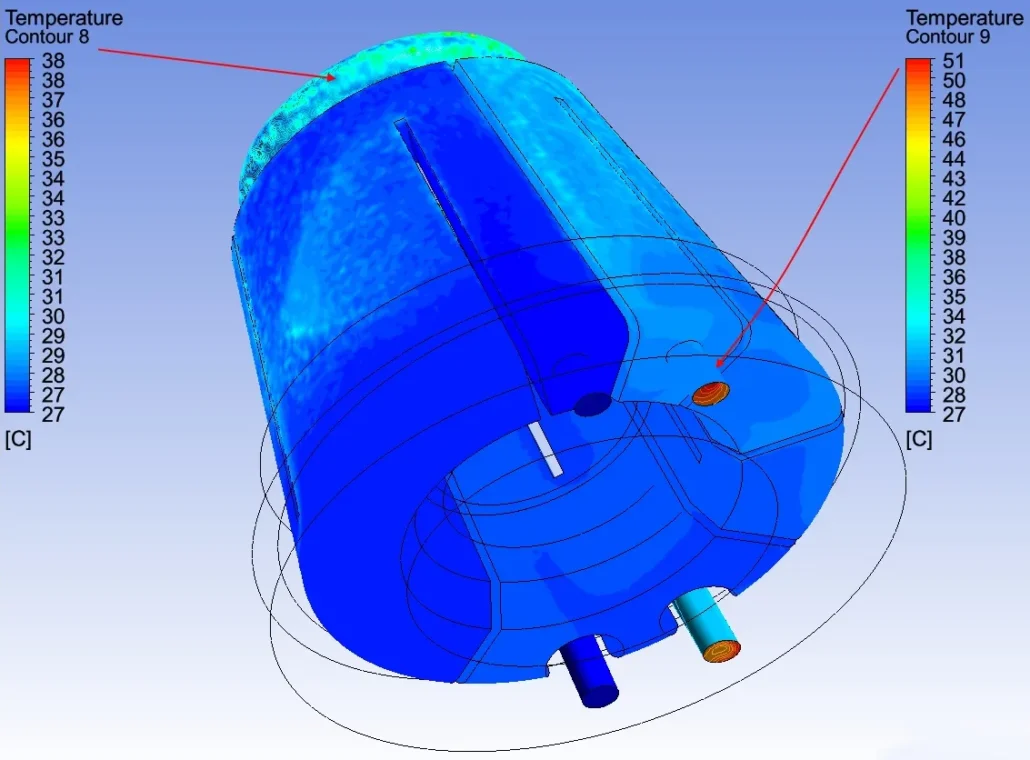
For solving the above-mentioned problems, M HEAVY TECHNOLOGY experts can analyze and determine the causes of lining wear at the customer’s request and find optimal blast furnace operating modes by means of modern CFD software systems.